19 July 2010

Wild & Wonderful

RWT and I just returned from a trip to West Virginia.  Since our main goal was rest and relaxation, we planned things a little backwards and first found a B&B that looked nice and quiet and then found things to do in that area.  And that turned out to be a good plan.

We ended up at Chestnut Ridge Country Inn B&B in Dunmore, Pocahontas County.  Nearby is the National Radio Astronomy Observatory that puts a damper on all electromagnetic interference in a rather wide area (the Quiet Zone) and that means no cell phone reception.  None.  But we did want peace and quiet.

The B&B was great with the owners hitting the perfect blend of friendliness without being overly hovering.  And they served us very nice breakfasts -- which ended up being our best meal of the day on this trip.  Dunmore is a tiny little town although central to pretty much everything we ended up doing. 

On our way there on Thursday, we stopped by Seneca Rocks and did what turned out to be a hot and humid trek to the top.   

Not sure the view from on top was worth it, but this sign along the trail was worth seeing.  And the visitor center was very nice with a good selection of guides including the newly published second edition of "Birding Guide to West Virginia" that I ended up purchasing because it contained the exact sort of information I had been looking for (although the Pocahontas County website was also pretty good in that regard).  It was quite birdy near the visitor center and that was where I saw my first warbler of the trip -- a redstart.  Also, many chipping sparrows, cedar waxwings, red-eyed vireos and scarlet tanagers.  I might have heard a yellow-throated warbler along the river, but I did not figure out the song until we were in the car and headed down the road.

We checked into the B&B late in the afternoon and then went in search of dinner.  That was the biggest downside to the trip -- the lack of good restaurants.  The first night we ate at Dorie's Home Cooking Restaurant and Lounge in Marlinton mainly because we'd heard they had sweet potato fries.  It was clean and the food was fine, but I enjoyed my BLT more than RWT did his pre-formed hamburger.  The next night we had dinner at the Foxfire Grille at the Village at Snowshoe Mountain which was slightly tastier food, but with an overall Disneyfied feeling to the whole experience.  And, on our last night, we ate at the Greenbrier Grille.  Wow.  They now have the (dis)honor of serving me the worst meal of my life.  The menu was nearly the exact same Sysco food as at Dorie's, but they could not even manage to cook the french fries until they were done.  Ugh.  The only things going for them were the view and the wi-fi access (after three days of no internet/cellular service, I was feeling more than a little cut-off from the world).  I think if we go next time, we will take our grilling tools, a bag of charcoal, pick up some supplies at a local grocery store and make our own dinner on one of the grills at the many state/national park picnic sites.

After dinner on Thursday, we took what turned out to be the first of three walks along the Greenbrier River Trail, an 80-mile long rail-to-trail path.  We parked at the burned-out railroad depot in Marlinton and headed north for about a mile and a half.  Unfortunately, that way goes through what appears to be the "bad" part of Marlinton and we ran into a lady who confirmed that south on the trail was the prettier direction.  However, we did find this cute little snapper along the trail.

On Friday morning, we headed to the huge Monongahela National Forest, specifically the Gaudineer Scenic Area.  It is 140-acres of red spruce forest that was never logged because of a surveying error.  On the way to the the picnic area at Gaudineer Knob, we heard lots of birdsong including black-throated green warbler, magnolia warbler, redstart, scarlet tanager, golden-crowned kinglet, hermit thrush, junco and one that it took me far too long to figure out -- winter wren.  In fact, the whole area was crawling with winter wrens, with one about every 300 yards along the trails.
Many of the wildflowers were in full bloom, including huge patches of red monarda (bee balm) that were each guarded by a hummingbird.  

The forest near the picnic area is nearly all red spruce and very mossy.  It looked quite a bit like the area of the Canaan Valley Wildlife Refuge where Cheep took us (me, EES and the Norwegians) last summer.
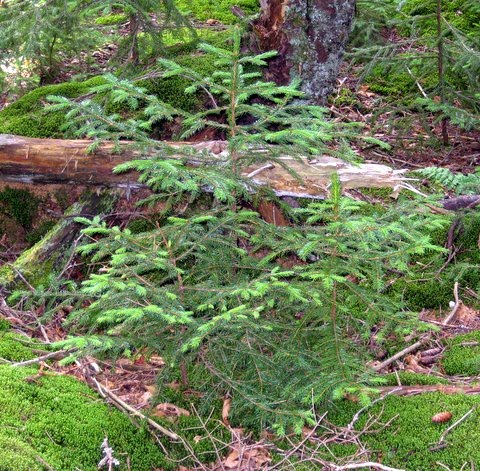
 The little spruces are so cute, I just want to hug them!

I felt like I needed a little red riding hood to go wandering through this forest.

 Cool moss and lichen (which reminded me of that mind-controlling game from ST:TNG).

And don't even get me started on all the neato rocks that I wanted to bring home for our yard.  

After walking around the picnic area and seeing the first warbler for the day (a maggie), we drove a mile down to the Virgin Spruce Interpretive trail.  Sadly, the original-growth red spruce are all just about at the end of their lifespans and the majority have fallen.  However, it is still a thriving mixed conifer/hardwood forest (more than around the picnic area which was nearly all-spruce) with gorgeous scenery such as this little stream.

From the interpretive loop, we walked for about an hour down the Allegheny trail until we somehow lost the trail and then we headed back up to the road to walk back to the car.

 Here is a lovely mushroom screaming "don't touch me!"

We also found this adorable slimy salamander along the trail. 

Coincidentally (?), this rock cairn (the only one we saw along the trail) was right where we found the salamander (you can see the piece bark where the salamander was hiding out to the left of the rocks).  A salamander marker?

But that was not our last salamander of the day. We saw this little guy cruising along the gravel road when we were walking back to the car.
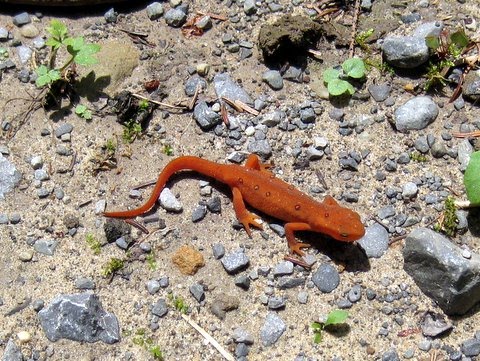
Once we got back to the car, we decided to take the back roads to get to our next destination:  Cass.  On the gravel forest service road on the way out from Gaudineer Knob we saw a family of wild turkeys.  Four adults and at least a dozen youngsters running around with them. Once back at the main road (250), we took Back Mountain Road (county road 1, from 250 to 66) and, boy, did that turn out to be a good decision.

2.1 miles north of the church at Wanless, is a small boggy area.  Approaching it, a brown thrasher flew right in front of the car and RWT wanted to know what it was, so he stopped the car.  At that point, we could hear common yellowthroats singing and I commented that there must be a pond or a body of water nearby.  We drove to the bottom of the hill and pulled over near some trees.  

While trying to figure out what turned out to be yet another indigo bunting (female), a bunch of birds flew into the trees.  They were some of the seemingly ever-present cedar waxwings, goldfinches, a couple of gnatcatchers and a bunch of chestnut-sided warblers.  I was trying to sort through them all when I realized the one yellow-capped bird was not just another chestnut-sided...  it had a black throat!  Yup, it was a golden-winged warbler.  I'd been hoping to spy a blue-winged, but never did I think I'd find a golden-winged. 

Eventually, all the birds flew over to the woods on the other side of the road and we continued on our way.  Although we did stop to say "hi" to this toad (I'm assuming an American toad since it had one bump per spot) and shoo it off the road.

On next stop was Cass Scenic Railroad State Park with rides on the gear-driven trains and an old-timey historic town.  It is one of the main tourist draws in the area and most of the people staying at the B&B were in there to ride the train.  We arrived in Cass too late in the day take a ride (or, what RWT really wanted to do, tour the shop), but we did time it perfectly to see a train come into the station.


We then, as I wrote earlier, drove up to Snowshoe Mountain for dinner.  The most interesting thing about Snowshoe is that all of the resort is at the top of the mountain, unlike most California ski resorts.  While up there, we saw a number of well-padded mountain bikers who were using the trams to get back up to the top of the slopes.  And lots of ravens soaring around.

After dinner, we parked at the northern terminus of the Greenbrier River Trail in Cass and walked a couple of miles south on the trail.  This netted me even more warblers for the day...  black & white, redstart, blackburnian, hooded (that one popped up when I was trying to spish in an indigo bunting with a very odd song) and a first-year nashville (another bird I did not expect to see).

 Cool rocks along the Greenbrier Trail.  

Can you spot the nest?

Here it is!  A phoebe nest perhaps?

Lots of milkweed blooming along the path and also this purple fringed orchid.  I've also never seen so many butterflies as I did on this trip.

The next morning (Saturday) we headed to the Cranberry Glades Botanical Area.  We had an early thunderstorm that day and it was raining buckets when we got to the visitor center.  Red crossbills have been reported to hang out in the trees around there, but the weather was not cooperating.  However, they had a very nice collection of snakes inside including:  copperhead; timber rattler; watersnake; ring-necked, red-bellied and smooth green (all together in a tank); milksnake; black rat; black racer; and eastern garters.  With multiples of most of them. And a ranger who obviously likes snakes.
 

After the rain started to let up, we did the boardwalk loop and then set off from there to do the ~7-mile (by the time you walk back to the car) Cow Pasture hike.  The plants were gorgeous with the rhododendrons and turks cap lily still in bloom.

But all of the water that lead to beautiful plants, also lead to a lot of insects.  After a mile or so being totally bombarded by various flies and gnats, we were dreaming of net-shrouded hats.  However, we kept going with the interesting plants and animals enticing us forward.


Birdwise, I'd been hearing mourning warblers singing since the boardwalk.  However, RWT had pretty much exhausted his supply of birding tolerance on the previous day and standing around being attacked by insects while trying to spot a lurking mourning warbler was not on his agenda.  So, sadly, I heard at least a dozen mournings, but did not see a single one.  Surprisingly, I also heard a prairie warbler near the edge of one of the open areas.  Other birds for that hike were both (!) kinglets, an insistently calling red-shouldered hawk near the boardwalk, common yellowthroats, swamp sparrows and yet more, frustratingly silent, empidonax flycathers.

This hike was also full of salamanders and a few frogs that I could never manage to catch up with.  More red efts on the move...


And there was a tiny (1.5" long) dark olive, with blotches on its back, salamander at one of the streams that I could not hold on to long enough get a picture of.   It was hanging out at the edge of the stream and jumped into the stream to avoid capture, but always pretty much stayed on the tops of rocks rather than hide under them.  Any guesses?

Because I was looking down at the ground for crawly things, I missed the most exciting part of this hike when there was a black bear on the path ahead.  By the time RWT called my attention to it, it had fled, so no bear for me and I had to be satisfied with the scenery.

Due to the long hike and previously-mentioned disappointing dinner, we went back to the B&B to lounge around in the hammock for the rest of the evening and watch the meadowlarks poke around in the field behind the B&B.

And, before we knew it, it was Sunday morning and time to think about heading home.  We took one more stroll along the Greenbrier River Trail (from just a bit south of mile-marker 67 to mile-marker 65) and it turned out to be the most picturesque section we walked.  Some time recently (the disturbed plants were newly-wilted), a large section of rocks had fallen onto the trail.


It was a nice way to finish up our trip and we came across an area full of chipping birds, so while RWT walked ahead, I managed to spot a family of common yellowthroats, red-eyed vireos, carolina wrens, indigo buntings (as smug as ever) and a worm-eating warbler.

Then it really was time to head home.  Fittingly, we returned to Alexandria in DC-style -- with an hour delay due to the closing of I-66E because of an accident. A sign that we should have stayed in West Virginia longer?

-------------------------------------------------
Birders:

If you are looking for warblers in July, the mountains of West Virginia are a place to consider. I saw/heard 14 species and that was with only one day of anything that resembled serious birding. 

Missed birds I'd hoped to see:  black-throated blue, blue-winged and canada warblers; red crossbills; purple finches; pine siskins; any vireos other than red-eyed; red-breasted nuthatches; and brown creepers (probably because I didn't have EES around to "call" one for me).

Other notable birds of the trip:  kildeer and eastern meadowlarks in the fields around the B&B; many ravens; bank and barn swallows; numerous, yet silent, empidonax flycatchers; lots of Carolina, house and winter wrens (there always seemed to be one of them calling wherever we went); phoebes, peewees and great-crested flycatchers; groups of crows on the ground out in the fields; veery, hermit and wood thrushes; red-shouldered hawks up close and personal (twice within 15'); juncos, juncos and more juncos; and towhees galore!

Birds of the Monongehela National Forest Checklist

08 April 2010

Malted Milk Ball Blondies

This one is still a work in progress...  a couple of weeks ago, I made the Malted Milk Ball Blondies from Baked, New Frontiers in Baking by Matt Lewis and Renato Poliafito.  I thought they were a little too sweet and a smidge greasy.  Also, while they had good malt flavor immediately after baking, it had disappeared by the next day.  

Although everyone liked the first batch, I made them again the next week and used less sugar, less butter and upped the malt powder (and decreased the flour because of the changes in  amounts of butter/malt powder).  But then they were too dry and not quite sweet enough.  Not really an improvement (however, my guinea pigs liked that batch too).  At least the malt flavor was a little more pronounced.

I'll probably make these yet again since I love all things malted, but I think I will try to find another blondie recipe that produces the nice chewy blondies that I like and tweak that by adding chopped malted milk balls and malt powder.

Garlic Scallion Noodles

No, I'm not falling behind in making new recipes, I'm just lagging in blogging about them.  Why?  Spending too much time out watching the birdies.  What else?!?

I made this recipe for Garlic Scallion Noodles the other night.  It sounded great.  And also quick and easy.  And I had everything on hand.  But, unfortunately, both RWT and I found it disappointing.  

It was a little bland and I found the sweetness (I added the lessor amount of brown sugar) a little odd in this application even though I usually like savory/sweet combinations.  Perhaps it was missing acid?  There is some leftover and maybe I'll give it a splash of black vinegar when I finish it off.

No pictures for this one, the ones in the link above are much nicer than I could ever take.

05 April 2010

Pan de Horno

Spanish Bread

To go with the Spanish-Style Meatballs, I will be making this Spanish-Style Bread (Pan de Horno) for my next gourmet group dinner.  It is not an earth-shattering bread.  Just a plain, white bread.  The most notable thing about it is that it has that somewhat elusive thin yet crisp crust that makes for really good sandwich rolls.

I suspect the crust is the result of working some olive oil into the flour before adding the water. The oil coats the proteins in the flour and prohibits some of the gluten development, so it  also results in a bread with a nice tender crumb (again, perfect for sandwich rolls).  But, while the oil helps to delay staling, this bread is definitely best when eaten within a few days and you'll lose that neato crust after the first day.

The recipe can be found here and you might want to halve it because it makes a lot of bread.   I ended up grinding about 1/3 of the leftover bread into bread crumbs to use later.  

This bread will probably never be the star of a meal, but it can play a very nice supporting role.  Especially supporting the insides of a sandwich. 

29 March 2010

Tapas Experiment #3


Testing out this recipe for next month's Gourmet Group get-together also went pretty smoothly.  I made my own puff pastry instead of the store-bought called for in the recipe.  I also inadvertently doubled the almonds (half were supposed to be reserved to sprinkle on top of the turnovers) and omitted the green bell pepper (it is a very subtly-flavored filling and I cannot see how bell pepper would not totally overwhelm it).

The recipe instructed to make crescents using a 4" round cutter, but I think a 3" round cutter makes a more tapas-friendly size.  Docking the dough helped to keep the turnovers from splitting open while baking.  And no differences (other than an additional minute or two of baking time) could be detected between: turnovers made immediately before baking; the ones made the day before and refrigerated;  and those that where made the day before and frozen.  So, for the party, I'll most likely make them a few days before and freeze them.

When I tasted the filling alone, it seemed to be a bit too mild, but it really compliments the puff pastry nicely.  But I imagine it would also work well to use pie or empanada dough.  The only other thing I will do differently for the ones for the party will be to chop the almonds a bit (and use the correct amount) and be sure the chicken is diced very small.  It would not matter much with the bigger 4" turnovers, but it should make the small ones a little easier to put together.

A very tasty and unusual recipe and one that I can see making for other get-togethers.

Puff Pastry Crescents with Saffron Chicken and Almonds

Makes ~24 pastries, 12 servings

3 tablespoon olive oil
1 medium onion, finely chopped
3 large cloves garlic, finely chopped
1/2 pound boneless skinless chicken breasts, cut into small dice
1/4 cup brandy
1 tablespoon tomato paste mixed with 1/4 cup water
1 pinch saffron threads, crumbled
1 teaspoon smoked Spanish paprika
1/4 cup sliced almonds
salt and pepper

1 pound homemade or store-bought puff pastry dough, defrosted if necessary
1 egg, beaten with 1 tablespoon water

In a large skillet, heat the olive oil over medium-high heat, then cook the onion until golden brown, stirring frequently.  Add the garlic and chicken and cook, stirring, until browned.  Add the brandy and, once it has evaporated, add the tomato paste mixture, saffron, paprika and almonds.  Cook until most of the liquid has evaporated, 4-5 minutes.  Add salt and pepper to taste.  Let cool to room temperature.

Preheat oven to 425 degrees.

Roll out the puff pastry dough on a lightly floured work surface to ~3/8-inch thick.  Cut into 3" diameter rounds, place a scant teaspoon of filling in the center of each round, fold the dough over to form a crescent, and crimp the edges closed with the tines of a fork.  Brush the surface of each pastry with egg wash.  Place on a baking sheet and bake until golden, 10-12 minutes.  Serve warm.

Recipe adpated from:  Little Foods of the Mediterranean by Clifford A. Wright

The Last Time I Get a Cooking Idea from a Comic Strip

I read last Friday's Brewster Rockit and thought "hmmm, how would my favorite yeast-raised waffle batter recipe work cooked on a griddle as pancakes?"  

I know that pancake batter usually needs to be thicker than waffle batter and that particular waffle batter is very thin, so I added an extra half-cup of flour to the recipe.  But when I cooked the first batch of pancakes, the batter was still too thin, so I add more flour.  Then it was too thick, so I added more milk.  But regardless of the thickness of the batter, it simply did not make good pancakes.

It could have been due to all the stirring involved with the adding of the flour and then the liquid to get the right consistency, but the pancakes were rather tough.  And  seriously lacking in salt.  However, the most notable attribute is that they tasted more of English muffins than pancakes.  So I'll stick with my favorite buttermilk/sourdough pancake recipe and save this recipe for the waffle iron:

YEASTED WAFFLES
Makes ~8 waffles

This recipe comes from “Cookwise” by Shirley Corriher and it is my absolute favorite waffle recipe, especially when served with maple syrup. The fact that almost all the measuring and mixing is done the night before, makes cooking these waffles the next morning a breeze.

2¼ teaspoons (1 package) dry yeast
½ cup water, warm
2 cups milk, warm
8 tablespoons (1 stick) unsalted butter, melted
1 teaspoon sugar
1 teaspoon salt
2¼ cups bleached, all-purpose flour

2 large eggs
½ teaspoon baking soda 

Sprinkle the yeast over the warm water in a very large mixing bowl and stir until dissolved. Add the milk, butter sugar, salt, and flour and beat until smooth. Cover the bowl with plastic wrap and, if the ambient temperature is above 70 degrees, put the batter in the refrigerator overnight. If the ambient temperature is less than 70 degrees, you can leave the batter at room temperature overnight.

When ready to cook the waffles, beat the eggs and baking soda into the batter. The batter should be quite thin, and most waffle irons will need ½ to ¾ cup of batter. Bake in a hot waffle iron and serve waffles immediately.

28 March 2010

Tapas Experiment #2

I decided on Manchego-Stuffed Dates for my third, previously undecided, tapa.  But how to specifically make them?  We had a taste test of the following:

1.  Manchego + Date + Olive Oil + Sea Salt -- Room Temperature
2.  Manchego + Date + Olive Oil + Sea Salt -- Warm
3.  Manchego + Date + Surryano Ham --Room Temperature (pictured above)
4.  Manchego + Date + Surryano Ham -- Warm

We decided the best were #2 and #3, with #2 just edging out the ham version because you could taste more of the cheese and dates.  Plus, there will be a couple of tapas  that evening that will contain chorizo, so that is probably enough cured meat for one party (although some people might argue that you can never have too much cured meat!).

Manchego-Stuffed Dates

Makes as many as you have the patience to stuff

Pitted Dates
Sheep-Milk Manchego Cheese
Extra-Virgin Olive Oil
Sea Salt

Cut the cheese into ~1/4"x1/4" sticks, about the same length as your dates.  Cut a slit in each date and insert a piece of cheese.  Bake stuffed dates, cut side up, at 350 degrees for ~10 minutes until the cheese starts to melt.  Remove the dates from the oven, let cool 5 minutes, drizzle with a bit of olive oil and sprinkle lightly with sea salt.  Serve warm.

(You can hold the stuffed dates in the refrigerator for a day or two before baking and serving.)

24 March 2010

Cheese Marbles?


In Little Foods of the Mediterranean by Clifford A. Wright, I saw an intriguing recipe for Cheese Marbles. Yeah, it was one of those recipes I read and thought to myself that is too easy, too obvious, it will never work.  And, you know what?  It didn't.

It is basically cheese mixed with flour, rolled in breadcrumbs and baked.  I used the cream cheese that was first choice in the recipe, added a bit of smoked paprika for flavor, baked them up and they tasted like raw pie crust.  Not that I have anything against raw pie crust, but I suspect it is a bit of an acquired taste.  So I baked them so more...  still tasted of raw flour, they were just not a soft as before.

Ah well, I can't expect them all to be good new recipes. 

23 March 2010

Tapas Experiment #1

I made Spanish-Style Meatballs for dinner last night and they came out really well.  In fact, so well that I will use the recipe as I made it for the gourmet club dinner.  Yeah, not much experimentation was required for this one.

But that is not saying I did not make some changes to the recipe I used as a starting point (click on the "Printable Version" link to get a fun surprise!).  I tweaked the spice levels (I did not want the nutmeg and cinnamon to be too prevalent), used a bit more meat (because it came in 1-pound packages).  I also used the milk-soaked bread method rather than dry breadcrumbs.  And, for the sauce, be sure to chop the onions finely and substitute red pepper flakes for cayenne (feel free to use more -- I was aiming for a gentle heat since it will be served to a varied group of people).

The next experiment will be Manchego-Stuffed Dates. Warm or room temperature?  Ham-wrapped or not? Sprinkled with sea salt or truffle honey or ???  Hmmm...

Spanish-Style Meatballs in Spicy Tomato Sauce


Spanish-Style Meatballs in Spicy Tomato Sauce
Serves 4-6 as main course, 8-10 as appetizer

Meatballs:
8 ounces ground pork
8 ounces ground veal
2 cloves garlic, crushed
1 teaspoon ground coriander
1 teaspoon ground cumin
1/2 teaspoon ground nutmeg
1/2 teaspoon ground cinnamon
1-1/2 teaspoons salt
1 egg
1 cup fresh bread crumbs + 3 tablespoons milk, stirred together

2 tablespoons olive oil

Tomato Sauce:
1 tablespoon olive oil
1 onion, finely chopped
2 cloves garlic, crushed
1/2 cup dry white wine
16-ounce can crushed tomatoes
1 tablespoon tomato paste
1/2 cup chicken stock
1/2 teaspoon red pepper flakes
salt

Directions:
Combine the pork, veal, garlic, spices, salt, bread/milk mixture and egg in a bowl. Mix by hand until fairly smooth and leaving the side of the bowl. Refrigerate, covered, for 30 minutes.

Roll tablespoons of the mixture into balls and dredge in flour. Heat 1 tablespoon of the olive oil in a skillet and toss half the meatballs over medium-high heat for 2-3 minutes, or until browned. Drain on paper towels. Add the remaining oil if necessary and brown the rest of the meatballs. Drain on paper towels.

For the spicy tomato sauce, heat the oil in a saucepan over medium heat and add the onion. Cook, stirring occasionally, for 3 minutes, or until transparent. Add the garlic and cook for 1 minute. Increase the heat to high, add the wine and boil for 1 minute. Add the tomatoes, tomato paste and stock and simmer for 10 minutes. Add the pepper flakes and meatballs. Simmer for 5-10 minutes, or until thick and the meatballs are coated in sauce. Add salt to taste.  Serve hot.

22 March 2010

Duck Eggs

No, not to eat...
On the left is a Hooded Merganser egg and on the right is a Wood Duck egg.  Both from the same nest box at Huntley Meadows Park.

This last week has been filled with bird-stuff and garden-stuff, so no new recipes.  In fact, RWT was lucky he got any dinner on a few nights.  

But I'll do better this week since I will be testing out the recipes for the next gourmet club get-together.  I think I've finally decided on my third tapa -- Manchego-Stuffed Dates.  I might try to work some Surryano ham into it also.  Stay tuned...

16 March 2010

Tapas!

For my OSC Gourmet group, I'll be making tapas for next month's get-together.  I will need to bring three different kinds.  The first will be meatballs with an allioli sauce (exact recipe TBD).  The second with be puff pastry turnovers filled with almond/saffron chicken (recipe from Clifford Wright's Little Foods of the Mediterranean).  And I still need to decide on the third. 

One of the other members of the club is bringing three veggie-centric tapas. (marinated carrots, tomato/avocado and eggplant)  And another is making two tapas that are based on chorizo and  also garlic shrimp.  So I was thinking of possibly doing one with cheese or potatoes or both.  Just nothing fried because I don't want to mess up the host's kitchen more than I have to.  Recipe suggestions are most definitely welcome and watch this space the results of my tapas experiments.

Fried Chickpea Patties With Sesame Seed Sauce (Revithokeftedes me Tahini Saltsa)


I ran across this recipe for Fried Chickpea Patties With Sesame Seed Sauce and it sounded too good not to try.  However, it ended up being a bit of a disappointment.  But I think it was more my fault than any issues with the recipe.  

I suspect I whirred the garbanzos too long in the food processor because the texture of the patties was somewhat pasty.  I also had a difficult time keeping the oil at a temperature that  was hot enough to keep the patties from absorbing oil, but not so hot that they got too brown.

The best part of the dish was the accompanying tahini sauce.  While uber-garlicky, it was totally delicious.  So I'll probably keep looking for a recipe for better patties, but I'll definitely use that sauce again.  Maybe with my favorite eggplant patties.